Intermittent Earth Leakage Fault Investigation
A customer site requested support to investigate and identify an intermittent earth leakage fault occurring on a panel. What followed was a methodical investigation revealing multiple interconnected issues — none of which were the obvious first assumption.
Earth Leakage Relays Found Faulty
Upon arrival on site, it was quickly identified that both earth leakage relays installed within the machine panel were faulty. Further complications arose due to the machine panel having been manufactured in India, with the installed relays and associated current transformers only readily available within the Indian market.
Extensive investigation was carried out to obtain datasheets and technical information relating to the installed relays and current transformers. No useful technical documentation could be sourced. It was therefore decided to replace both the earth leakage relays and their associated current transformers with suitable alternatives available within the UK market.
No Genuine Earth Fault Found
While awaiting delivery of the replacement equipment, extensive testing was carried out on the machine and its associated circuits to identify any genuine earth leakage faults. No insulation failures or earth leakage issues could be identified during this testing process — a significant finding that suggested the fault was not a genuine earth leakage condition.
Thyristor System Creating Supply Disturbances
Once the replacement relays and current transformers had been installed and the machine returned to operation, further investigation identified that the fault only occurred after the thyristor heating system had achieved its desired operating temperature and entered its control phase.
During this phase, the thyristor system pulsed in order to maintain temperature control. It was during these pulse events that the supply voltage experienced substantial disturbances. Further monitoring identified that when the thyristors fired, the voltage monitoring relay in the panel momentarily dropped out the control voltage for a fraction of a second. This brief interruption removed power to the earth leakage relays momentarily — which in turn falsely triggered the earth leakage fault condition.
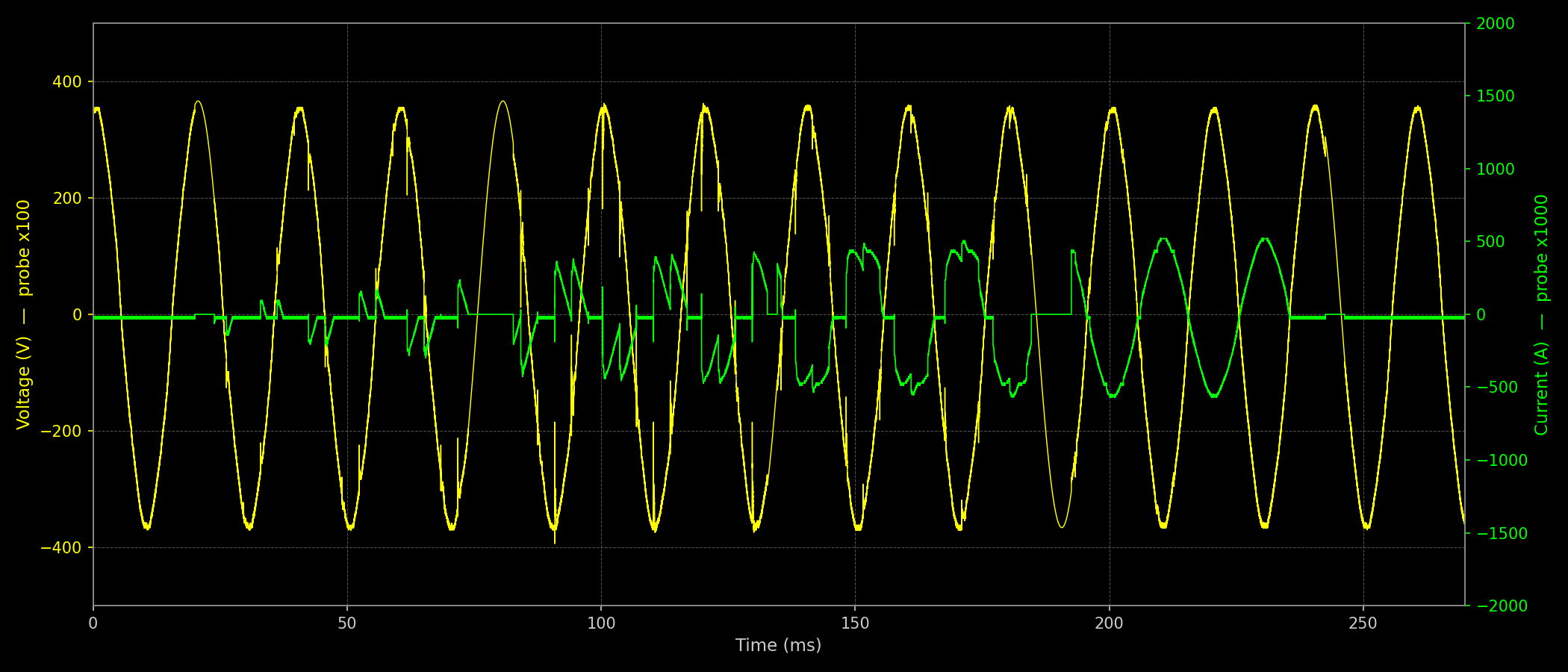
CH1 (Yellow) — Supply Voltage | CH2 (Green) — Current | Thyristor switching disturbances visible across multiple cycles
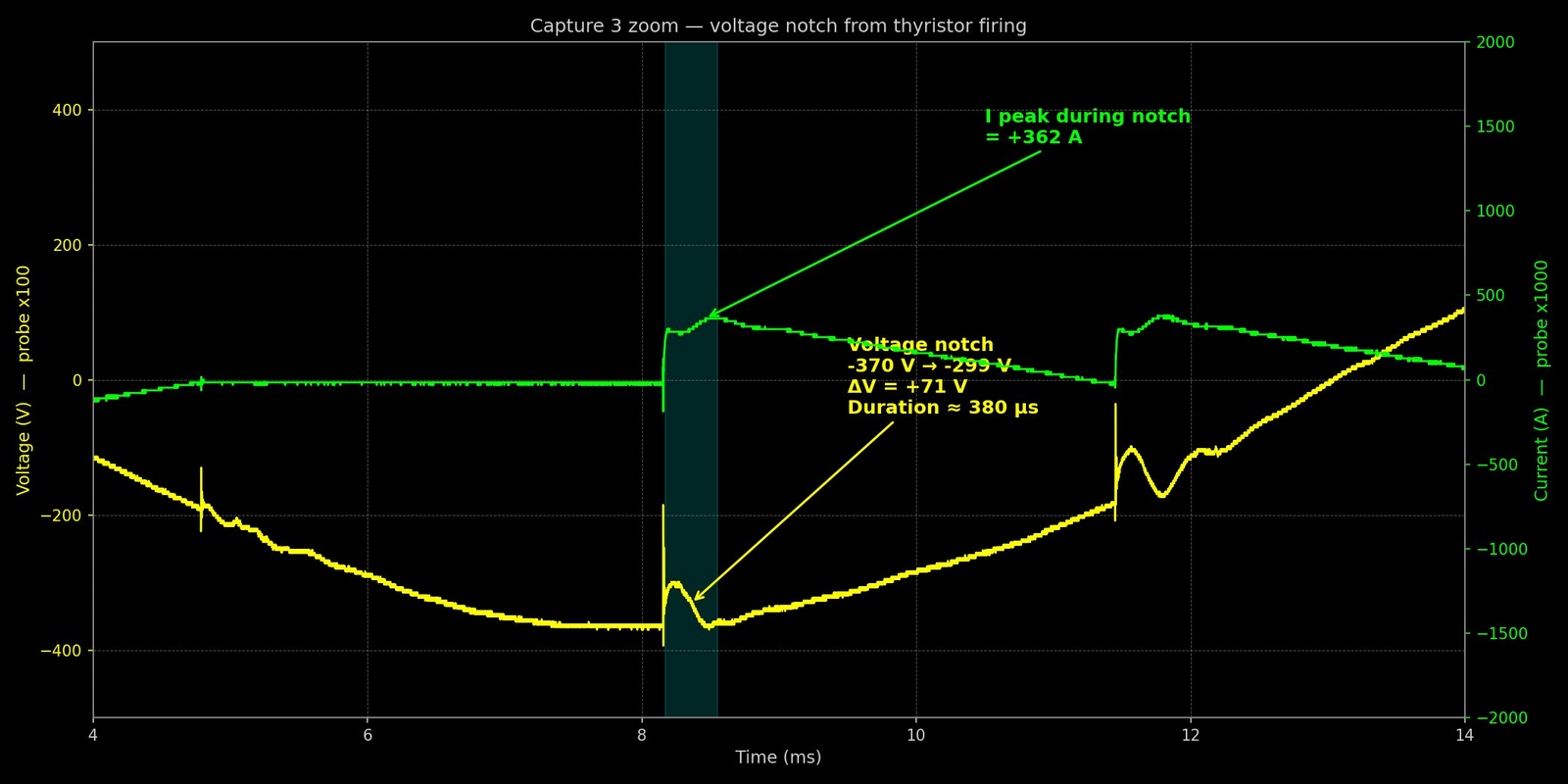
Zoomed capture — voltage notch from thyristor firing | ΔV = +71V | Duration ≈ 380μs | Current peak 362A
Voltage Monitor Settings Adjusted
Additional investigation identified that the voltage monitoring relay had been configured incorrectly and was set too tightly for the realistic supply variations present on site. The voltage monitor relay settings were adjusted to more realistic operational tolerances, allowing the system to tolerate expected transient voltage variations without nuisance tripping.
Emergency Lighting System
During discussions with the customer, it was highlighted that the emergency lighting system throughout the facility would sometimes flicker on and off during operation of the heating system. Despite the customer having previously purchased a costly harmonic control system panel specifically to combat the harmonic issue, supply disturbances were still impacting the emergency lighting system.
Isolation Transformer Recommended and Fitted
As part of the investigation, an isolation transformer was recommended to be fitted to the emergency lighting system. An isolation transformer works by electrically separating the secondary circuit from the primary supply using electromagnetic induction rather than a direct connection. This means that transient voltage disturbances, harmonic content and switching noise present on the primary supply cannot directly couple through to the secondary circuit.
In this application, the thyristor switching events were generating voltage disturbances that propagated along the supply network and affected any equipment connected to it — including the emergency lighting circuits. By supplying the emergency lighting system through an isolation transformer, those circuits were effectively shielded from the disturbances on the main supply. The transformer's inherent impedance also attenuates high-frequency switching transients, providing a cleaner supply to the connected load.
Following installation of the isolation transformer, the emergency lighting system operated correctly without any further flickering issues.
Why the Existing Harmonic Panel Did Not Solve the Problem
Harmonic mitigation systems are designed to reduce harmonic current content in the supply — typically the steady-state distortion caused by non-linear loads. However, the disturbances generated by thyristor switching are transient in nature — short-duration voltage events rather than continuous harmonic distortion. These transients are not effectively addressed by harmonic filters, which is why the existing harmonic control panel provided no benefit to the emergency lighting system. The isolation transformer addressed the actual mechanism of disturbance coupling rather than the harmonic content.
Key Lessons
- Intermittent faults often have multiple contributing factors — systematic investigation is essential
- Earth leakage indications are not always caused by genuine earth faults
- Voltage monitoring relay settings must be appropriate for the actual supply conditions on site
- Harmonic mitigation and transient suppression are different problems requiring different solutions
- Isolation transformers are a highly effective solution for circuits sensitive to supply disturbances